
What is NCA ECC?
The National Cybersecurity Authority (NCA) Saudi Arabia is a crucial government agency focused on safeguarding the Kingdom’s digital infrastructure from cyber threats. With a mission to bolster the nation’s cyber defenses, the NCA operates at the forefront of cybersecurity strategy, policy formulation, and implementation.
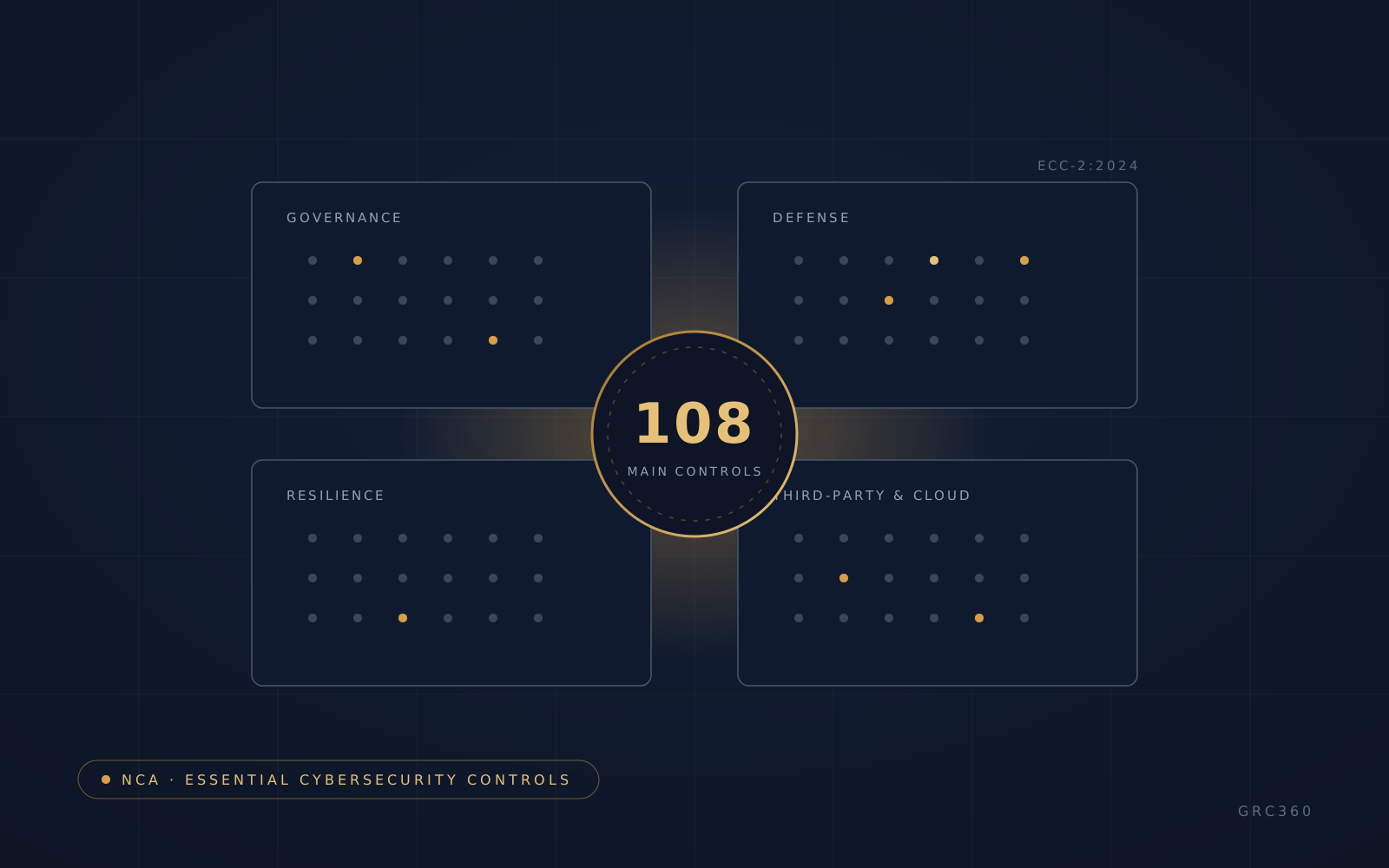
The NCA ECC (Essential Cybersecurity Controls) is a comprehensive cybersecurity framework introduced by Saudi Arabia’s National Cybersecurity Authority. Its purpose is to establish unified cybersecurity standards across public and private sectors, safeguarding the Kingdom’s digital infrastructure against cyber threats and supporting Vision 2030 objectives. The current version is ECC-2:2024, which supersedes the original ECC-1:2018 and is the edition against which the NCA now measures compliance.
The framework sets the minimum cybersecurity requirements that in-scope entities must implement to strengthen their cybersecurity posture. These controls are designed to address governance, defense, resilience, and third-party and cloud computing cybersecurity, ensuring that organizations adopt a proactive and structured approach to cybersecurity.
Unlike global standards such as ISO 27001 or NIST, the NCA ECC is tailored specifically for Saudi Arabia’s regulatory and operational landscape, making it an essential compliance requirement for organizations operating in the Kingdom.
To Whom Does NCA ECC Apply?
The scope of work defined in ECC-2:2024 is precise about who must comply. Compliance is mandatory for:
- Government agencies — ministries, authorities, establishments, and other public-sector organizations in the Kingdom of Saudi Arabia.
- Affiliated companies and entities of government agencies — including those operating inside and outside the Kingdom, a clarification introduced in ECC-2:2024.
- Private-sector owners, operators, or hosts of Critical National Infrastructure (CNI) — organizations in sectors such as energy, telecommunications, finance, healthcare, and transport whose systems underpin essential national services.
For all other entities in the Kingdom, the ECC is not mandatory — but the NCA strongly encourages every organization to leverage the controls as best practice to improve and enhance its cybersecurity. In practice, many private-sector organizations adopt the ECC voluntarily because clients, partners, and other Saudi regulators increasingly expect alignment with it.
Note also that applicability varies within the framework itself: for example, the controls in Subdomain 4-2 (Cloud Computing and Hosting Cybersecurity) are binding only on entities currently using or planning to use cloud computing and hosting services.
Why You Need NCA ECC Compliance
Achieving ECC compliance is more than just meeting a regulatory requirement; it is a strategic step toward safeguarding your organization’s reputation, data, and operational continuity. Below are some of the key reasons why your organization needs NCA ECC compliance:
- Regulatory obligation — for government agencies, their affiliates, and CNI operators, compliance is mandatory; non-compliance may lead to penalties, reputational damage, or loss of business opportunities in Saudi Arabia.
- Improved cybersecurity posture — ECC ensures organizations implement strong governance and defense mechanisms against cyber threats.
- Risk reduction — by aligning with ECC, organizations minimize the risk of cyber incidents, data breaches, and service disruptions.
- Business continuity — ECC compliance strengthens resilience against attacks, ensuring uninterrupted operations.
- Client and partner trust — demonstrating compliance enhances credibility with clients, partners, and stakeholders.
- Alignment with Vision 2030 — supporting the Kingdom’s national vision requires businesses to be secure, resilient, and digitally ready.
In short, NCA ECC compliance not only protects your organization from regulatory and security risks but also positions you as a trusted partner in the Saudi marketplace.
Domains of NCA ECC
The NCA ECC framework is built on a structured approach that ensures organizations in Saudi Arabia implement cybersecurity in a holistic and systematic way. The current version, ECC-2:2024, consists of 4 main domains, 28 subdomains, and 108 main controls (supported by 92 subcontrols).
ECC-2:2024 formally supersedes ECC-1:2018. The headline changes in the 2024 update are the removal of the former fifth domain (Industrial Control Systems Cybersecurity), whose controls moved to the NCA’s dedicated Operational Technology Cybersecurity Controls (OTCC); a clarified scope that expressly covers government agencies’ affiliated companies and entities inside and outside the Kingdom; and strengthened workforce requirements, including that all cybersecurity positions be filled by full-time, qualified Saudi cybersecurity professionals.
Domain 1: Cybersecurity Governance (10 subdomains)
- Cybersecurity Strategy
- Cybersecurity Management
- Cybersecurity Policies and Procedures
- Cybersecurity Roles and Responsibilities
- Cybersecurity Risk Management
- Cybersecurity in Information and Technology Project Management
- Compliance with Cybersecurity Standards, Laws and Regulations
- Periodical Cybersecurity Review and Audit
- Cybersecurity in Human Resources
- Cybersecurity Awareness and Training Program
Domain 2: Cybersecurity Defense (15 subdomains)
The largest domain, covering the technical and operational safeguards that protect the entity day to day. Its 15 subdomains span:
- Asset, identity, and access management — Asset Management; Identity and Access Management.
- Systems, network, and infrastructure protection — Information Systems and Information Processing Facilities Protection; Email Protection; Network Security Management; Mobile Devices Security; Physical Security; Web Application Security.
- Data protection and cryptography — Data and Information Protection; Cryptography; Backup and Recovery Management.
- Threat and vulnerability management — Vulnerability Management; Penetration Testing; Cybersecurity Event Logs and Monitoring Management; Cybersecurity Incident and Threat Management.
Domain 3: Cybersecurity Resilience (1 subdomain)
- Cybersecurity Resilience Aspects of Business Continuity Management (BCM) — embedding cybersecurity requirements within the entity’s business continuity management to withstand and recover from cyber incidents that could disrupt critical services.
Domain 4: Third-Party and Cloud Computing Cybersecurity (2 subdomains)
- Third-Party Cybersecurity — managing the cybersecurity risks of outsourcing, managed services, and other external parties.
- Cloud Computing and Hosting Cybersecurity — requirements binding on entities that currently use, or plan to use, cloud computing and hosting services.
Our Methodology for NCA ECC Compliance
At GRC360, we follow a structured methodology to guide organizations through their ECC compliance journey. Our approach is designed to be practical, efficient, and tailored to each client’s unique operational environment.
Step 1: Gap Assessment
We begin with a detailed audit of your current cybersecurity practices against the NCA ECC framework. This allows us to identify gaps, weaknesses, and areas of non-compliance.
Step 2: Roadmap Development
Based on the assessment, we create a customized compliance roadmap. This roadmap prioritizes actions, allocates resources, and sets achievable milestones.
Step 3: Implementation Support
Our consultants work closely with your teams to implement the required cybersecurity controls across governance, operations, and technical infrastructure.
Step 4: Training and Awareness
We conduct workshops and training programs to ensure that your employees are fully aware of their cybersecurity responsibilities.
Step 5: Compliance Audit
Once controls are in place, we perform an internal audit to validate compliance readiness before any official regulatory review.
Step 6: Continuous Monitoring and Improvement
Cybersecurity is not a one-time exercise. We provide ongoing consultancy and monitoring to ensure your organization remains compliant as regulations evolve and new threats emerge.
Why Choose Us for NCA ECC Compliance in Saudi Arabia
Choosing the right partner for NCA ECC audit, consultancy, and compliance services can make all the difference. Here’s why leading organizations in Saudi Arabia trust us:
- Local expertise with global standards — we combine knowledge of Saudi compliance requirements with international best practices like ISO 27001, NIST, and CIS Controls.
- Proven track record — our team has successfully guided multiple organizations across sectors to achieve ECC compliance.
- Industry experience — we have extensive experience working with government entities, critical infrastructure, and private organizations in Saudi Arabia.
- End-to-end services — from audits and consultancy to compliance implementation and training, we offer a complete solution under one roof.
- Client-focused approach — our methodology is tailored to your unique environment, ensuring practical and cost-effective compliance.
- Commitment to excellence — we are dedicated to helping your organization not just achieve compliance but build a resilient cybersecurity culture.
Partner with the Leading ECC Compliance Experts in Saudi Arabia
The NCA ECC framework — now in its ECC-2:2024 edition — is an essential requirement for in-scope organizations in Saudi Arabia and the national benchmark for everyone else, ensuring stronger cybersecurity, regulatory compliance, and resilience against evolving threats. Achieving ECC compliance requires expert guidance, a structured approach, and a trusted partner who understands both the local regulatory environment and international standards.
At GRC360 we are a leading IT consulting and compliance firm in Saudi Arabia, specializing in providing NCA ECC audit, consultancy, and compliance services. With decades of combined experience in international cybersecurity frameworks and Saudi-specific compliance requirements, we guide organizations toward achieving and maintaining ECC compliance effectively and efficiently.
GRC360 is there to help you every step of the way, from initial assessment to full compliance and beyond. Our team of experts will ensure your organization meets all regulatory requirements while strengthening your overall cybersecurity maturity.