What is SAMA ITGF?
The Saudi Central Bank (SAMA) Information Technology Governance Framework (ITGF) is a comprehensive regulatory framework that establishes the minimum requirements for IT governance across financial institutions in Saudi Arabia. It ensures that IT systems, processes, and practices are aligned with business objectives, resilient against risks, and compliant with SAMA’s standards.
The SAMA ITGF defines policies, roles, and responsibilities to ensure that Information Technology contributes effectively to organizational performance while maintaining security, compliance, and operational efficiency. By implementing this framework, organizations demonstrate their ability to manage IT resources responsibly, control risks, and support long-term business continuity.
In simple terms, the Information Technology Governance Framework under SAMA acts as the backbone of IT management for financial entities, setting a structured pathway to achieve operational excellence and regulatory compliance.
To Whom Does SAMA ITGF Apply?
The SAMA ITGF requirements apply to all financial entities licensed and regulated by the Saudi Central Bank (SAMA), including:
- Banks and financial institutions — ensuring IT governance supports critical banking services and aligns with business strategy.
- Finance companies — securing technology platforms for lending, investment, and credit operations.
- Payment service providers and fintech firms — managing governance of digital platforms, mobile payments, and customer-facing applications.
- Any SAMA-regulated entity — compliance with the Information Technology Governance Framework is mandatory across the financial ecosystem.
Note that insurance companies are no longer SAMA-regulated: supervision of the insurance sector transferred to the independent Insurance Authority (operational since 23 November 2023). GRC360 supports insurers in meeting the equivalent IT governance expectations under the Insurance Authority’s regime.
By applying ITGF, these organizations strengthen IT oversight, reduce risks, and align their IT strategies with regulatory and business objectives.
Domains Covered Under SAMA ITGF
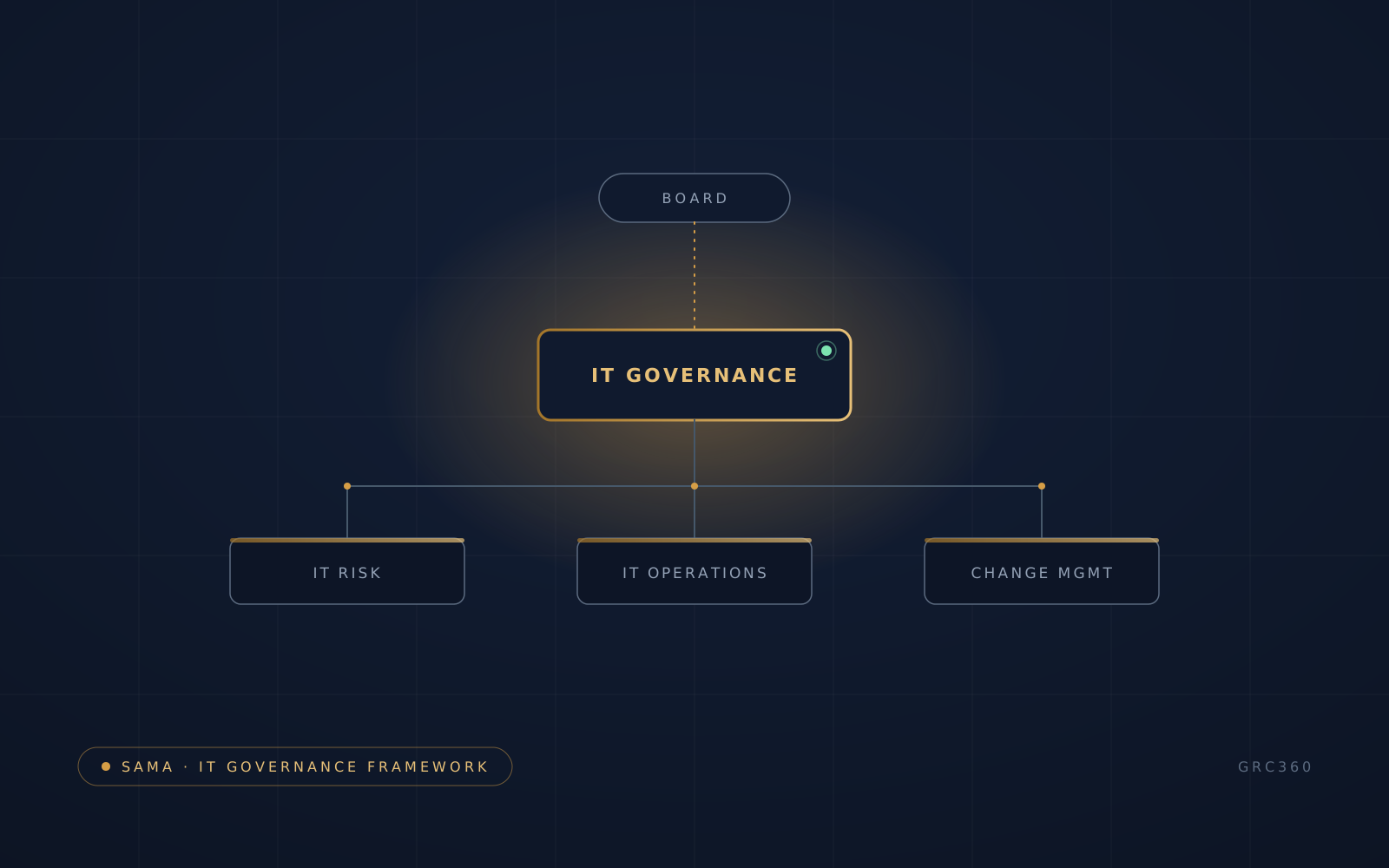
The SAMA ITGF (Information Technology Governance Framework) is structured into four key domains that cover the essential areas of IT governance.
Information Technology Governance and Leadership
This domain emphasizes strong leadership and oversight of IT within the organization. It ensures that IT policies, objectives, and decision-making processes are aligned with the overall business strategy. Clear roles, responsibilities, and accountability structures are established at the board and executive levels to maintain transparency and control.
Information Technology Risk Management
Effective IT governance requires a robust risk management framework. This domain focuses on identifying, assessing, mitigating, and monitoring IT risks, including cybersecurity, operational disruptions, compliance breaches, and third-party risks. IT risk management ensures organizations are resilient to threats while maintaining compliance with SAMA and international standards.
Information Technology Operations Management
Operations management ensures the stability, availability, and performance of IT services. This includes monitoring IT infrastructure, managing service levels, and ensuring continuity of critical systems. Proper operational management minimizes downtime, supports disaster recovery, and ensures consistent service delivery to customers.
System Change Management
This domain governs how changes to IT systems, applications, and infrastructure are managed. It ensures that modifications are properly assessed, tested, approved, and documented before implementation. Effective change management reduces the risk of system failures, enhances security, and ensures compliance with regulatory expectations.
Together, these domains provide a holistic framework to strengthen IT governance and align technology with organizational goals.
SAMA ITGF Maturity Levels
SAMA ITGF introduces maturity levels to measure how well organizations have implemented IT governance practices. Each level reflects the organization’s progress toward achieving governance excellence.
- Level 0 — Non-Existent — no formal IT governance processes are in place. IT risks are unmanaged, and compliance is absent.
- Level 1 — Ad Hoc — some governance processes exist but are inconsistent, informal, and reactive. Risk management is minimal.
- Level 2 — Repeatable but Informal — governance activities are partially implemented and repeatable but lack structure and integration across the organization.
- Level 3 — Structured and Formalized — IT governance processes are well-defined, documented, and consistently applied. Risk management and oversight are structured.
- Level 4 — Managed and Measurable — IT governance is monitored through KPIs, metrics, and regular reporting. Continuous improvement practices are applied.
- Level 5 — Adaptive — governance is fully embedded in the organization’s culture. Processes are automated, proactive, and aligned with international best practices.
Our Methodology for SAMA ITGF Compliance
We provide comprehensive SAMA ITGF consultancy, audit, and compliance services through a structured methodology tailored to your organization’s size and complexity. Our approach includes:
- Gap assessment — reviewing your existing IT governance structures against SAMA ITGF requirements.
- Framework development — designing governance frameworks, policies, and procedures aligned with the four ITGF domains.
- Risk & maturity assessment — conducting IT risk assessments and evaluating your maturity level on SAMA’s 0–5 scale.
- Implementation support — assisting in embedding governance controls, risk management practices, and operational processes.
- Change management advisory — establishing processes for controlled system changes and IT environment updates.
- Monitoring & metrics — designing KPIs and reporting structures to measure IT governance performance.
- Training & awareness — delivering workshops for IT leaders, executives, and staff on IT governance responsibilities.
- Audit & assurance — providing independent audits and assurance reports to demonstrate compliance with SAMA ITGF.
Our methodology ensures that your IT governance framework is not only compliant but also effective, efficient, and sustainable.
Why You Need SAMA ITGF Compliance
Compliance with SAMA ITGF is crucial for financial institutions in Saudi Arabia. The benefits include:
- Regulatory alignment — avoid penalties by meeting mandatory IT governance requirements.
- Risk reduction — minimize IT and cyber risks through structured governance practices.
- Operational efficiency — improve IT service availability, stability, and performance.
- Informed decision-making — strengthen leadership oversight with measurable IT governance metrics.
- Change control — reduce failures and security incidents caused by poorly managed IT changes.
- Customer confidence — demonstrate strong governance, resilience, and compliance to stakeholders.
- Strategic alignment — ensure IT investments and projects support long-term business objectives.
By adopting SAMA ITGF, organizations enhance resilience, efficiency, and trustworthiness in the financial sector.
Why Choose Us
Partnering with us for SAMA ITGF compliance audit and consultancy services ensures that you are working with experienced professionals who understand both local regulatory requirements and global best practices.
- Specialized expertise in SAMA standards — extensive experience with SAMA ITGF, CRFR, CSF, BCMF, and MVC, ensuring deep understanding of regulatory expectations.
- Comprehensive end-to-end services — from gap assessments and remediation planning to audits and ongoing advisory, we provide complete compliance support.
- Tailored compliance strategies — customized solutions that align security and resilience requirements with your unique business model and operational needs.
- Proven track record in the Saudi financial sector — trusted by fintech startups, financial institutions, and regulated entities across the Kingdom.
- Practical and business-oriented approach — recommendations designed to achieve compliance while minimizing disruption and supporting long-term growth.
- Focus on sustainability — we help embed IT governance into your organizational culture for long-term success.